The Australia-China Chamber of Commerce and Industry
of New South Wales


GUANGDONG PROVINCE(廣東省)

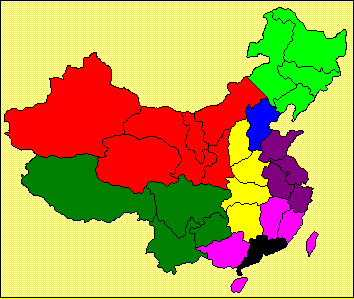
Guangdong is shown in black.

Note that Chinese names are in MingLiU (Chinese Traditional) screen font.  This may appear as question marks or other symbols if that font is not installed on your browser.


General Profile:


Population: 86,400,000

Provincial Capital: Guangzhou

Average temperatures: 8 deg C to 17 deg C in January; 27 deg C to 29 deg C in July.

Physical features: The province is situated on the Tropic of Cancer, with hills to the north and lowlands to the south.  It has a humid monsoon climate with a rainy season from April to September.  The area of the province is 177,901 square kilometres.

Rivers: The Pearl River dominates with its tributaries: Xi River to the west, Bei River to the north and the Dong River to the east.

Administrative divisions: 15 cities, 73 counties and 3 autonomous counties.

Historical significance: Guangdong became part of the Chinese Empire during the Ch’in and Han dynasties, but was not extensively populated by Han Chinese until the 12th century.

Guangzhou became China’s pre-eminent port in the 17th century, and the city developed as a major gateway for trade.  This position was subsequently lost to Shanghai.  For more detail see China’s Pearl River Delta. 


Natural Resources:


Guangdong is endowed with a wealth of mineral reserves, of which pyrite, zircon and silicon rank first in China in terms of deposits and output.  In addition, iron ore, tungsten, molybdenum and coal are mined in the region.

Oil was discovered in 1979 on the Leizhou Peninsula (to the north of Hainan Island) and offshore reserves are said to be abundant.  The province is China's fifth largest crude oil production base with an annual output of over 12.8 million tons in 1999.


Economic Profile:


1999

2000

Economic Indicators

Value

Growth

Value

Growth


(% p.a.)


(% p.a.)

Gross domestic product (RMB bn)

846

9.5 *

951

10.5 *

Per capita GDP (RMB)

11,739

5.0

N/A

N/A

Disposable income per capita


  - urban (RMB) 

9,126

3.2

9,762

7.0

  - rural (RMB)

3,629

2.9

3,654

0.7

Fixed asset investment (RMB bn)

293.7

11.1

320.6

9.2

Value added by sector


  - primary (RMB bn)

102.1

1.6

99.0

-3.0

  - secondary (RMB bn)

426.4

6.8

485.3

13.8

  - tertiary (RMB bn)

317.9

8.8

366.3

15.2

Retail sales (RMB bn)

365.6

10.2

407.2

11.4

Inflation (CPI, %)

-1.8


1.4


Exports (US$ bn)

78.8

3.2

93.4

18.5

  - by FIEs (US$ bn)

39.4

0.6

49.5

25.6

Imports (US$ bn)

64.7

17.2

82.1

26.9

  - by FIEs (US$ bn)

33.9

6.9

42.5

25.4

Foreign direct investment


  - number of projects

3,013

-30.7

4,243

40.8

  - contracted amount (US$ bn)

5.5

-40.2

11.5

109.1

  - utilised amount (US$ bn)

11.7

-3.0

11.3

-3.4

Notes: *Estimated
Sources:
Statistical Yearbook of Guangdong and National Bureau of Statistics of China.


Infrastructure:


Water Transport -- Guangdong has more than 51 state-approved ports.  In recent years, container ports at Shenzhen have developed rapidly.  Some 54 per cent of Shenzhen's total container throughput was handled in Yantian, while 27 per cent was handled in Shekou(蛇口)and 16 per cent in Chiwan(赤灣).  Port facilities in Guangzhou are also expanding rapidly (see China’s Pearl River Delta).

Yantian International Container Terminals (YICT) is capable of accommodating the 4th generation container vessels.  Yantian, which is now the second largest in China in terms of container handling capacity, is able to handle more than 2 million TEUs a year.  When the planned phase 3 expansion project is completed, Yantian will be able to play a more active role in promoting Shenzhen's overall port transportation service. 

Railways -- The province is a major railway hub in southern China, providing easy transport to most parts of the country.  Major railways running through the province include the Beijing-Guangzhou Lines(京廣線)and the Beijing-Kowloon Railway(京九線).  The opening of the Beijing-Kowloon Railway has shortened the travel time between Guangzhou and Beijing to 27 hours. 

Travel time from Guangzhou to Shantou was also shortened to about 10 hours with the Guangzhou-Meizhou-Shantou Line(廣州-梅州-汕頭).  A new railway, the  Guangdong-Hainan line(粵海鐵路通道)connecting Zhangjiang in Guangdong with Sanya in the Hainan Island, is under construction.  It is to be completed in 2003.

Highways -- Road links have been greatly improved with the completion of Guangzhou-Shenzhen Expressway(廣深高速公路)and numerous locally-funded highways such as the Shenzhen-Shantou Expressway.  The Humen Bridge(虎門大橋)which connects the Guangzhou-Shenzhen Expressway with the Guangzhou-Zhuhai Highway is now in operation. 

During the Ninth Five-Year Plan, coastal expressways have been planned for the eastern and western parts of the province.  The Guangdong authorities also plan to build a network of 25 major roads linking major cities of the province with Hong Kong and Macau.

Air Transport -- The province has 7 civil airports (including Guangzhou Baiyun, Guangzhou Huadu, Zhuhai, Shenzhen, Shantou, Zhanjiang).  Direct flight services are available to most major domestic cities.  There are also international flight services to Manila, Bangkok, Singapore, Brisbane, Jakarta, Kuala Lumpur, Los Angeles, Melbourne, Sydney, Seoul, and Hong Kong at the Guangzhou Baiyun International Airport. 

A new Baiyun International Airport was approved by the State Council in July 1997 and is currently under construction.  It is expected to complete by 2010 to handle 80 million travellers and one million tons of cargo annually.

Telecommunications -- Guangdong has one of the most advanced telecommunication networks in the country.  At the end of 2000, mobile phone subscribers in Guangdong were over 12.5 million, accounting for about 12 per cent of the country’s total.   By the end of March 2001, the mobile phone penetration rate was 18.4 per cent, which enables the province to be ranked third after Beijing and Shanghai. 

Electricity -- Electricity supply in the province is ample.  The total installed electric power generating capacity in the province was over 30 million kWh by the end of 1999.  In addition to the existing nuclear power station(大亞灣核電站), which has a capacity of 1.8 million kWh, the provincial government plans to build a second nuclear power station nearby.


Agriculture:


The province's agricultural output ranked the fifth in the country, assisted by its capacity to grow two crops of rice each year.  Rice, sugar cane, fruit and fish are major agricultural products.  Aquaculture in the province led the nation in 2000.

Other products include: potatoes, corn, sorghum, millet, wheat, peanuts, soybeans, sesame, tea, ambary hemp, jute, sun-cured tobacco, bananas, oranges, lychees, pineapples, and other tropical fruit, rubber, oil palm, sisal hemp, coffee, cocoa, lemongrass and pepper.


Industry:


In 2000, the province's total industrial output was RMB1,224.5 billion and was ranked the highest among all provinces in China.  Major industrial production bases included Guangzhou, Shenzhen, Foshan, Huizhou and Zhuhai.

Guangdong has the largest production base for light industries in China.  Output of light industries accounts for over half of the province's total industrial output.  Consumer products including electrical appliances such as television sets, electrical fans and refrigerators, garments, bicycles, toys, shoes and various electronic items.  

Guangdong also developed into a major export-processing base for investors from Hong Kong, Macau and other foreign investors.  Foreign-invested enterprises now account for about 60 per cent of Guangdong's industrial output. 

In the coming years, the provincial authorities plan to invest heavily in infrastructure projects; develop a strong production base of automobile, electronics, iron and steel, building materials; and expand the tertiary sector.

Guangdong's external trade totalled US$175.5 billion in 2000, accounting for 39.8 per cent of the country's total and ranked the top among all provinces and municipalities.

Exports amounted to US$93.4 billion in 2000.  Major export items included agricultural products, chemicals, electrical appliances, electronics, textiles, garments, toys and shoes. 

Imports totalled US$82.1 billion in 2000.  Major imports included raw material and other resources-based intermediate goods, electronics, machinery, and complete set of equipments.


Science and Technology:


The Pearl River Delta Open Economic Zone(珠江三角洲經濟開發區)

The Pearl River Delta Open Economic Zone covers an area of 42,000 square kilometres, or about 25 per cent of the province's area.  Major cities and towns include: Guangzhou, Shenzhen, Zhuhai, Foshan, Jiangmen, Dongguan, Zhongshan, Huizhou, Huiyang county, Huidong county, Poluo county, Zhaoqing, Gaoyao and Sihui.  The zone's population, GDP and retail sales of consumer goods accounted for 31 per cent, 76 per cent and 68 per cent, respectively, of the province's total in 1999.

See China’s Pearl River Delta for further information.

Shenzhen Special Economic Zone(深圳經濟特區)

Covering an area of 391 square kilometres, the SEZ been developed into an export-oriented economic zone since its establishment in 1980. Its most developed industries include electronics, toys, food processing, textiles and garment.  By the end of 1999, a total of 23,608 foreign investment projects were signed, with contracted investment of US$29.8 billion.  Actually utilised foreign capital totalled US$20.1 billion.

Nearly 75 per cent of foreign investment in Shenzhen came from Hong Kong.  Those projects mainly involved in producing electronics, telecommunication tools, light building materials and machinery.  In recent years, Hong Kong investments have been diversified into the tertiary sector including property development, tourism, entertainment business, and computer services provision.

Exports by the zone grew by 26.4 per cent in 2000.  The city's exports totalled US$16.1 billion and accounted for 6.5 per cent of the country's exports.  The high-tech industries, especially the electronic and IT industries, dominate Shenzhen's export-oriented processing trade. 

Zhuhai Special Economic Zone(珠海經濟特區)

Covering an area of 121 square kilometres, Zhuhai SEZ developed into an export-oriented economic zone since its establishment in 1980.

The zone's major industries include electronics, toys, food processing, textiles and garments, and petrochemicals.  The local government strives to develop the zone into a high-tech production base.

In the 1990s, Zhuhai utilised more than 3 billion of foreign direct investment.  Most foreign investments involved in property development, tourism, electronics, garments, foodstuffs, toys, footwear, plastics and other light industries.  Major investment sources include Hong Kong, Macau, Taiwan, Japan, the US and the EU.  In 2000, the zone’s exports grew by 30.1 per cent to US$2.9 billion.

Shantou Special Economic Zone(汕頭經濟特區)

Covering an area of 376 square kilometres, Shantou SEZ was established in 1980 with the approval of the State Council to attract foreign direct investment and develop export-processing trade.  Major industries in the zone include chemicals, electronics, pharmaceuticals, textiles, machinery and garments. 

The zone is expected to become a powerhouse of hihg-tech industrial development within the next 10 years.  It will focus on developing electronics and information, bio-engineering, new materials and photo-electric industries.  The city plans to build six centres involving high-tech industrial development, modern agricultural demonstration and experiments, technological innovations and maritime activities.

Economic and technological development zones -- ETDZs, 經濟技術開發區)

Apart from the designated open economic zone and special economic zones, Guangdong has 11 state-level economic and technological development zones, 6 bonded zones and 59 provincial-level economic and technological development zones.  This includes:

Guangzhou Economic and Technological Development Zone(廣州經濟技術開發區)

Zhanjiang Economic and Technological Development Zone(湛江經濟技術開發區)

Nansha Economic and Technological Development Zone(南沙經濟技術開發區)

Huizhou Zhong Kai New and High-Tech Development Zone (惠州仲凱高新技術產業開發區

Foshan New and High-Tech Development Zone(佛山高新技術產業開發區)

Guangzhou Nansha Economic and Technological Development Zone (廣州南沙經濟技術開發區)

Shenzhen Industrial Park(深圳科技工業園)

Daya Bay Economic and Technological Development Zone(大亞灣經濟技術開發區)

Guangzhou Tianhe New and High-Tech Development Zone(廣州天河高新技術產業開發區)

Zhongshan Torch New and High-Tech Development Zone(中山火炬高新技術產業開發區)

Zhuhai New and High-Tech Development Zone(珠海高新技術產業開發區)


Consumers’ Market:


Guangdong is the largest consumer market in China though its population ranks the 4th largest among all provinces, municipalities and autonomous regions.  Retail sales of consumer goods increased by 11.4 per cent to RMB407.2 billion in 2000, accounting for 12 per cent of the country's total. 

Guangdong's retail sector is one of the most developed in China with a broad mix of retail outlets including department stores, shopping malls, supermarkets, specialty stores, chain stores and warehouse clubs.  Guangzhou and Shenzhen were selected by the State Council in 1992 as two of the 11 designated pilot cities to establish pilot Sino-overseas joint venture retail enterprises with import and export rights.

The Guangzhou Hualian-Broadway Co. Ltd., Guangzhou Zhengjia Enterprise (Commercial) Co. Ltd. and the Shenzhen Wal-Mart were approved by the State Council as three of the 19 pilot retail joint ventures in China.  Other major overseas-invested cooperative retail enterprises approved by the local government include Chia Tai Makro from Thailand (正大萬客隆), Wal-Mart from the US in Shenzhen, Carrefour from France, Jusco from Japan, and dozens of franchised chain stores (such as U2, G2000, Baleno, Bossini, Fortei, etc.) from Hong Kong.

Major department stores and shopping centres in Guangdong include Guangzhou Friendship Department Store(廣州友誼商店有限公司), Guangzhou Department Store(廣州百貨大樓), Guangzhou Xindaxin Co.(廣州新大新公司), Nanfang Shopping Centre(南方大廈), Dongshan Department Store(東山百貨大樓), Shenzhen Duty Free Shop Enterprises Group(深圳巿免稅企業集團有限公司), Guangzhou Chia Tai Makro Co.(廣州正大萬客隆), Zhuhai Duty Free Shop Enterprise Group(珠海巿免稅企業集團有限公司), Shenzhen Wanjia Department Store Co.(深圳萬佳百貨股份有限公司), Fushan Xinghua Shareholdings Co.(佛山巿興華股份有限公司), Shenzhen Tianhong Department Store Co.(深圳天虹商場有限公司), Guangzhou Huaxia Department Store(廣州華夏百貨公司), Zhuhai Department Store Co.(珠海百貨集團有限公司), Guangzhou Wangfujing Department Store Co.(廣州王府井百貨大樓有限公司), etc.


Key Cities in Guangdong Province:


Pearl River Delta Industrial Region – This comprises the cities in the region that surrounds the first three cities:

Ø       Guangzhou

Ø       Shenzhen

Ø       Zhuhai

Ø       Foshan

Ø       Dongguan

Ø       Huizhou (eastern portion of the region)

Ø       Zhaoqing (western portion of the region)

Eastern Industrial Region – This is based mainly on industries associated with rural output in that part of the province.

Ø       Shantou

Western Industrial Region – This is the site of a number of resource-intensive industries.

Ø       Zhanjiang


Guangzhou 廣州:


1999 data:

Population

GDP

Industrial Output

Retail Sales

('000)

(RMB bn)

(RMB bn)

(RMB bn)

6,850

205.7

201.2

66.6

Guangzhou occupies a pivotal position in the Pearl River Delta.  Products include processed food, textiles, steel, paper, cement, fertilizer, chemicals, motor vehicles, and machinery.  About 15 per cent of China’s foreign trade is conducted within the city and it is the site of a major bi-annual international trade fair.

Refer also to China’s Pearl River Delta.


Shenzhen
深圳:


1999 data:

Population

GDP

Industrial Output

Retail Sales

('000)

(RMB bn)

(RMB bn)

(RMB bn)

1,198

143.6

207.9

27.6

Shenzhen is across the canal from Hong Kong and benefited greatly from investment from the Special Administrative Region in the 1980s (when it was a Crown Colony).  Shenzhen was the first and the most important of the Special Economic Zones that characterise China’s initial “open door” policy.

Its initial reputation was mixed, as a result of poor working conditions and a thriving black market, but it rapidly became a boomtown.  Its growth rate reached 45 per cent during a peak period and this is said to be the highest in the world.

There are three Shenzhens, which causes some confusion.  Shenzhen City is located at the Lo Wu border crossing with Hong Kong; Shenzhen Special Economic Zone incorporates the area mainly to the east and west of Shenzhen City; and Shenzhen County extends several kilometres beyond the SEZ.

Production in the SEZ was mainly export processing until the latter part of the 1980s, when the zone moved rapidly into higher technology production.


Zhuhai
珠海:


1999 data:

Population

GDP

Industrial Output

Retail Sales

('000)

(RMB bn)

(RMB bn)

(RMB bn)

714

28.7

61.5

7.6


Zhuhai is the Special Economic Zone that was designed to attract investors from Macau.  Like Shenzhen, it was built on land that was formerly agricultural. 

Its growth rate was somewhat slower than Shenzhen’s, but it is rapidly catching up with numerous high-rise hotels, factories and dwellings for workers.  These developments pushed the industrial portion farther to the north of the zone.


Shantou
汕頭:


1999 data:

Population

GDP

Industrial Output

Retail Sales

('000)

(RMB bn)

(RMB bn)

(RMB bn)

4,489

45.5

29.4

15.7

Shantou is the third Special Economic Zone in Guangdong Province and is the main port in the eastern part of the province.  It was officially opened to foreign trade in 1860.  The port became a convenient stopping point on the sea journeys from Hong Kong to Fujian Province.  It is about 300 kilometres from Hong Kong and about 450 kilometres from Fuzhou.

Harbour facilities between Hong Kong and Shantou are rather poor, due to coastal silting and to mountain ranges that come close to the coast.


Foshan 佛山:


1999 data:

Population

GDP

Industrial Output

Retail Sales

('000)

(RMB bn)

(RMB bn)

(RMB bn)

3,292

83.4

138.4

20.4


Foshan has become a satellite city of Guangzhou, located less than 20 kilometres to the southwest.

It has recently become a major centre for information technology industries in the province.


Zhanjiang 湛江:


1999 data:

Population

GDP

Industrial Output

Retail Sales

('000)

(RMB bn)

(RMB bn)

(RMB bn)

6,571

38.0

14.6

10.7


Zhanjiang is a major port in the southern portion of Guangdong and is the largest one west of Guangzhou.  It was leased to the French in 1898 and remained under French control until World War II. 

French investment remains substantial, particularly in relation to oil exploration along the Leizhou Peninsula


Dongguan 東莞:


1999 data:

Population

GDP

Industrial Output

Retail Sales

('000)

(RMB bn)

(RMB bn)

(RMB bn)

1,508

41.3

60.4

9.2

Dongguan is situation about 50 kilometres east of Guangzhou and forms an important element in the Guangzhou-Shenzhen portion of the Pearl River Delta. 

Though smaller than Foshan, it also participates in the rapidly growing information technology industries.


Huizhou 惠州:


1999 data:

Population

GDP

Industrial Output

Retail Sales

('000)

(RMB bn)

(RMB bn)

(RMB bn)

2,718

39.2

69.5

8.4

Huizhou is in the eastern portion of the Pearl River Delta Open Economic Zone, though it would be considered outside the geographical area that is known as the Pearl River Delta.  It is about 100 kilometres east of Dongguan.

The area surrounding Huizhou is mainly agricultural and the city’s initial industrial enterprises developed from rural products.  The city subsequently attracted a number of electronics manufacturers and this now provides a large share of the output.


Zhaoqing 肇慶:


1999 data:

Population

GDP

Industrial Output

Retail Sales

('000)

(RMB bn)

(RMB bn)

(RMB bn)

3,812

39.2

38.1

7.8

Zhaoqing is about 90 kilometres west of Guangzhou and is classified as part of the Pearl River Delta Open Economic Zone.  Like Foshan, the city is expected to place increased emphasis on services such as science and technology, finance, commerce, trade and tourism. 

For Zhaoqing, the focus will be on the supply of these services to enterprises within the city and to its immediate hinterland.


Information Sources:


Information contained in this page was obtained from:

Hong Kong Trade Development Council (http://www.tdctrade.com)


Additional Information:


We are in the process of maintaining regular contact with organisations in the cities listed.  Please contact us if you require additional information about Guangdong Province or any of the cities listed.


Return to the top of this page.